
The first question was spatial
Before the wider city story could work, the first district needed a dependable route: shelter, depot, maintenance gate, Market Street and Metro Forecourt. Early environment scenes checked access to required objects, closed and repaired gates, a pump shortcut and clear return paths. These small tests established how a repair should change the space around the player.
An 8 × 8 km experiment
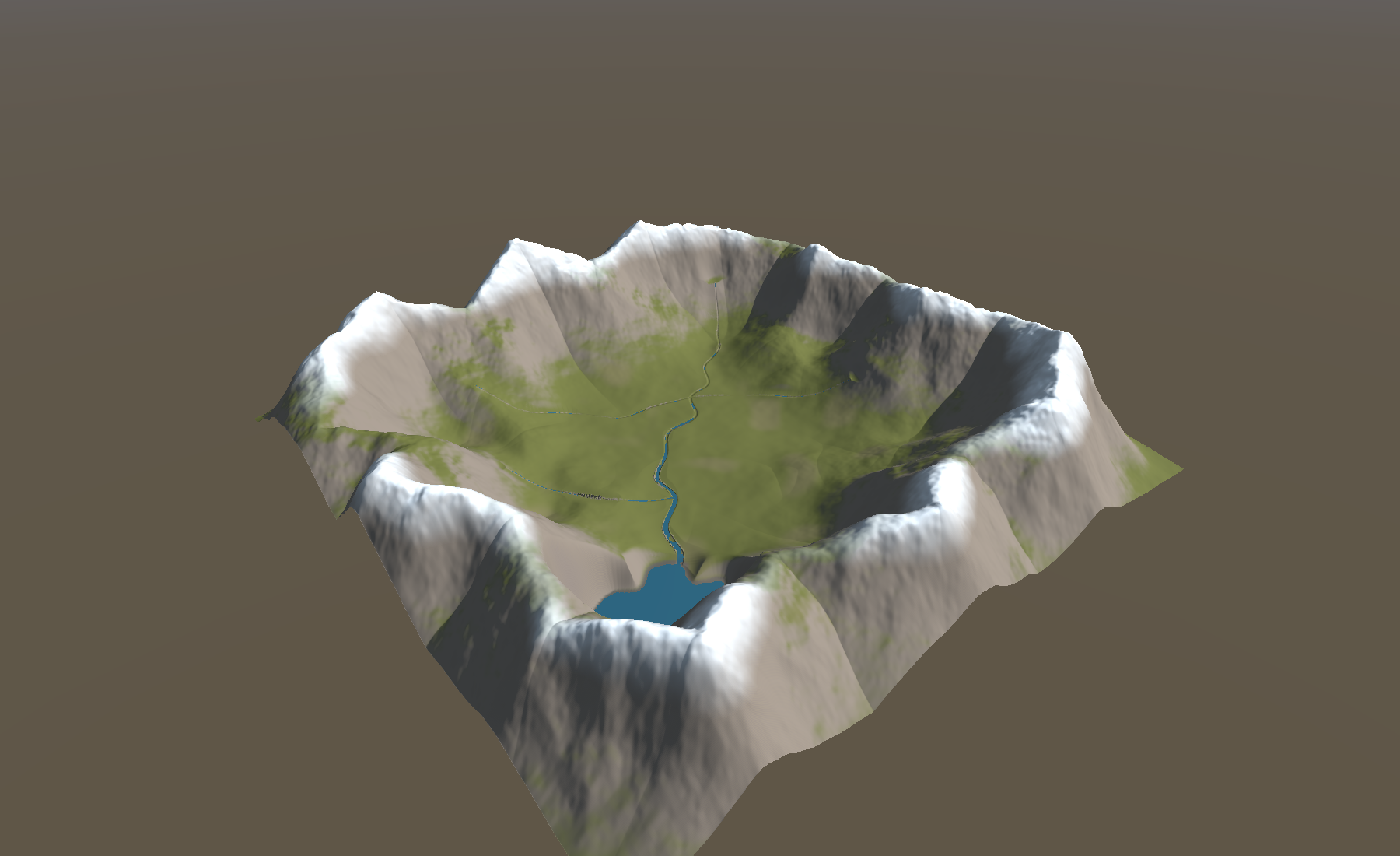
The next terrain work explored a broad fjord-and-valley setting on a shared height grid and sixteen terrain tiles. Mountains needed to frame every direction, including across the harbor water. River gradients, lake edges, mountain feet and sightlines from street height were treated as connected problems. This was an authoring experiment, not a promise of a finished 64-square-kilometre game map.
What the landscape reviews changed
Terrain profiles and collision checks could pass while the scene still looked wrong: hard water edges, long flat slopes, exposed rock undersides, floating roots and thin woodland strips remained visible. Separate studies measured terrain, mountains, water, roads, grass, trees, rocks, ground materials and performance. Several candidates were explicitly rejected rather than promoted into the main world.
Reference scenes were measured, not just copied
POLYGON reference areas were examined as actual 3D geometry: how a bridge meets its banks, how trees form a deep stand, how rock bases sit in terrain and how material transitions support the landform. Broad terrain-generation and real-elevation experiments did not establish the required result. A limited TerraLoom comparison was investigated, without a qualified full-world migration.
The current direction
The newer world contract prioritises authored, connected places and scene cells. The first substantial industrial pilot follows the service exit, stream crossing and workyard; later rooms attach to that route. Terrain, water, collision and story anchors must be designed together. The earlier terrain experiments remain useful history, but are not the current production world or an accepted final landscape.